


CCT in the Land of the Rising Sun

A field report from CCT 2026 in Kyoto written by Farhana Tabassum, BI Norwegian Business School
For the first time in its history, the Consumer Culture Theory (CCT) Conference came to Asia, bringing the CCT community to Japan’s cultural capital, Kyoto, under the theme “Tradition and Innovation”. I had the privilege of experiencing this milestone as an event volunteer. Working behind the scenes at Kyoto University’s Centennial Clock Tower Hall gave me a front-row seat for the conference and to a setting where historic architecture and modern academic exchange seemed particularly at home together.

From right to left: Co-Chairs Michelle Yang, Julien Cayla, and Yutaka Yamauchi at the inaugural speech
Celebrating 40 years of Consumer Behaviour Odyssey
A major milestone of CCT Kyoto 2026 was the celebration of 40 years since the Consumer Behavior Odyssey, a foundational moment in the development of CCT. Virtual keynotes from prominent scholars including Russell Belk and Søren Askegaard offered an opportunity to reflect on how far the field has come, while also looking ahead to how CCT methods must continue to evolve. Researchers were encouraged to actively seek out their toughest critics, whose skepticism can expose weaknesses, challenge assumptions, and ultimately sharpen fieldwork ideas.

University of Kyoto Clock Tower premises on a rainy day
Reshaping global consumer research
Not only is Kyoto the proud birthplace of many Japanese traditions, but it also has a significant history of innovation, exemplified by companies like Nintendo. CCT Kyoto brought renewed attention to making consumer research less Western-centric. This was reflected in several research presentations, such as vegan consumption in Japan, the wine market and its intermediaries in China, and community-based savings practices in Egypt, alongside a dedicated session on decolonization of markets. These contributions showed how familiar marketplace questions take on different meanings when examined through diverse cultural and institutional contexts. As the Conference Co-Chairs put it, bringing the conference to Kyoto was not simply about a new location, but an opportunity to rethink the CCT community and broaden the context through which consumer culture is understood. Rather than treating innovation as a simple replacement of the old by the new, the conference encouraged us to consider how technologies, traditions and everyday practices can evolve together.
More than papers and panels
CCT Kyoto extended beyond the main program through a series of associated events that brought a different rhythm to the week. These included a writing retreat, GENMAC (Gender, markets, consumers) 2026, which preceded the main conference, and more experimental activities such as ecstatic dance. Once the conference began, the program was similarly eclectic, combining working and competitive papers with focused forums, poetry, academic satire, posters, and a film festival. The result was a gathering that made room not only for presenting research, but also for writing, creativity, and less conventional forms of academic exchange. The main program itself opened with activities including a haiku workshop, A/R/T installations, and an industry panel before moving into the subsequent days of research sessions. The intellectual range was just as broad. Across the parallel sessions, conversations moved from sustainability, degrowth, care, gender, spirituality, decolonization, and the preservation of traditional practices to AI, platform culture and digital identities. Additionally, an interactive session on how CCT is taught in PhD programs, addressing the current challenges, was a major highlight.
One presentation that stayed with me was Chloe Preece and Pilar Rojas-Gaviria’s “Portals and pixels: The embodied enchantment of virtual reality”. Amid wider discussions of digital consumption, I found its focus on the embodied experience of emerging technology particularly intriguing.
Between conference days, attendees found time for the gardens of the Kyoto Imperial Palace, Arashiyama, Kyoto’s cute stationery shops, and the streets of Gion, sometimes with the surprise of crossing paths with a maiko (a regional term to denote female apprentice entertainer skilled in traditional Japanese arts).

Meanwhile in the sessions
Japan and its Paradox
One of the most fascinating macro-marketing discussions during the conference centered on a paradox defining the host nation. This tension surfaced in the research presentations too, notably in Steven Chen’s work on design longevity and institutional lock-in through the Toyota Crown Comfort Taxi. The idea of institutional lock-in resonated with a broader paradox often associated with Japan, a country that appeared to reach the “year 2000” in the 1980s, pioneering bullet trains, automation, hyper-efficient retail, and mobile technology long before much of the rest of the world, yet in some respects became culturally and structurally frozen in that very era. To date, Japan retains many analogue practices and established consumer routines combined with remarkable technological sophistication. For instance, cash-only transactions and coin-operated services remain part of everyday life, while the hanko, a traditional seal, continues to symbolize the persistence of analogue practices in administrative and business life. These practices, existing alongside high-speed rail, automation, and sophisticated digital infrastructure, create an intriguing coexistence of the new and the familiar. It was a fitting reflection of the conference’s broader theme.
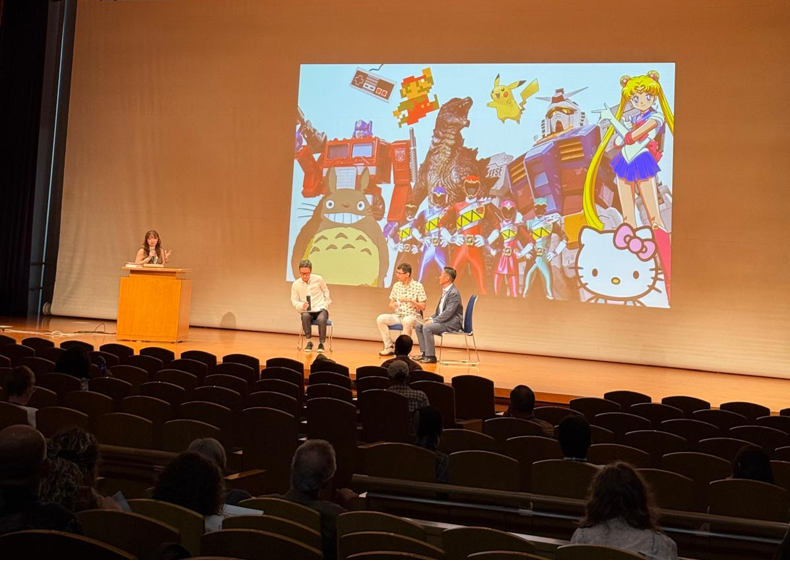
A panel discussion in progress
Hospitality the Kyoto way
Kyoto University’s hospitality gave the conference a character of its own. Much of the experience was carefully curated by Conference Co-Chair Michelle Yang, with thoughtful details that brought a little of Kyoto into the conference itself. From the reception on campus to tote bags with a kanji-inspired motif, handmade notepads, and conference mugs, even smallest touches felt considered. The hospitality carried into the conference days through bento-box lunches, chilled matcha, and mochi doughnuts between sessions. These created a special atmosphere between panels, giving scholars space to talk, linger, and get to know one another.

The reception spread
The social program was warm and generous. The welcome reception at Kyoto University brought everyone together over a plentiful buffet of Japanese cuisine, setting a convivial tone for the days ahead. The conference wrapped up on a celebratory yet reflective note, with the keynote, film screening, and awards recognizing contributions of young and experienced scholars to the field, alongside a memorial speech dedicated to the late Prof. Giana Eckhardt. With the promise of meeting again in Finland next year, the week closed with a gala dinner at Hilton Kyoto. The evening did not end there though. The dinner was followed by a Japanese-style nijikai, an informal second gathering that gave both the conversations and the conference a relaxed final chapter.
A discipline moving forward
In retrospect, I learnt from the conference that CCT's questions are only getting larger. Marketplace cultures, technological dominance, institutional inertia, and public policy - all are considered central to marketing, and CCT research has something unique to add. I will remember equally the space the conference made for PhD and early-career scholars. The conference not only asked hard theoretical questions, it actively made time for the people who will have to respond to these challenges in the future.

This article was written by
Farhana Tabassum
BI Norwegian Business School


Comments